
You've probably seen it on a bread bag, an ice cream carton, or a tub of powdered creamer. Sometimes the label says "mono- and diglycerides." On an imported biscuit it might say "emulsifier (E471)." On some packs it's just "471." Same ingredient family each time.
This guide covers what E471 is, why it's used, the names it goes by on labels, what the label can't tell you, and how to check it in a few seconds. It is not medical advice. Questions about your household's diet belong with your clinician.
The short answer: what E471 is
E471 is the European code for mono- and diglycerides of fatty acids. They're made by combining glycerol with fatty acids from edible fats and oils. U.S. regulations describe them as "a mixture of glyceryl mono- and diesters, and minor amounts of triesters, that are prepared from fats or oils or fat-forming acids that are derived from edible sources" (21 CFR 184.1505).
E471 isn't one single substance. The European Food Safety Authority (EFSA) notes that, depending on the fats used, it can contain more than 50 different mono- and diglycerides (EFSA, 2017).
Its job is to work as an emulsifier: it helps oil and water stay mixed, so textures come out smooth and even. The FDA puts the whole category simply: "Emulsifiers, stabilizers and thickeners give foods the texture and consistency consumers expect" (FDA).
Where you'll actually see it
E471 turns up in a lot of everyday foods. When EFSA checked a large EU database of product labels, E471 was listed on 33,090 food and drink products from 2012 to 2017. That was about 7% of products on average, and roughly 75% of dairy-based ice cream and frozen yogurt (EFSA, 2017). The categories where it showed up most:
- Bread and baked goods. EFSA found bread, rolls, and fine bakery wares were the biggest sources of intake for most age groups.
- Ice cream and chilled desserts, where it helps give a smooth texture.
- Margarine and spreads, where oil and water have to stay together.
In U.S. aisles, you'll also see it on powdered coffee creamer, cake mixes, frosting, and some peanut butters.
How E471 is named on real labels
The name you see depends on where the food was labeled.
| Where the pack was labeled | How it usually appears | What the rule says |
|---|---|---|
| United States | "mono- and diglycerides" (or "mono and diglycerides"), usually near the end of the list | Ingredients are listed "by common or usual name in descending order of predominance by weight" (21 CFR 101.4). U.S. labels don't normally use E-numbers. |
| EU and UK | "Emulsifier: E471" or "emulsifier (mono- and diglycerides of fatty acids)" | Additives are shown with their function plus their name or E-number (NHS; Regulation (EU) 1169/2011). |
| Countries using international (INS) numbers | "emulsifier (471)" | Some labels outside the EU and UK show the international (INS) number, 471, without the "E" in front. It is the same additive. |
Three label-reading examples:
- A typical U.S. sandwich bread: "…contains 2% or less of: salt, soybean oil, mono- and diglycerides, calcium propionate…" Because it's near the end, it's a small-quantity ingredient.
- The Fairhollow Original Coffee Creamer canister from our E471 ad (Fairhollow is a fictional brand). The line your thumb stops on reads "MONO- AND DIGLYCERIDES,". The hyphen after "MONO" is normal label shorthand for "monoglycerides and diglycerides."
- An imported European biscuit: "Emulsifiers (E471, soya lecithin)." Same ingredient, different naming system.
You may also see glyceryl monostearate, GMS, or distilled monoglycerides. These are closely related. EU rules list several of them as synonyms for E471, although EFSA notes they aren't exact chemical matches (EFSA, 2017).
Don't confuse E471 with its cousins
Several look-alike names belong to different additives. Here are three you're likely to see, from the UK's official list (FSA):
- E472a–E472f are esters of mono- and diglycerides: acetic, lactic, citric, tartaric, and so on. "Mono- and diacetyltartaric acid esters of mono- and diglycerides" (DATEM) is E472e, not E471.
- E322 is lecithins, a different emulsifier that often appears next to E471.
- E470a/E470b are salts of fatty acids.
If you're tracking a specific additive, read the whole phrase, not just "diglycerides."
What regulators say
- United States: the FDA affirms mono- and diglycerides as GRAS (generally recognized as safe). They can be used "with no limitation other than current good manufacturing practice" (21 CFR 184.1505).
- European Union: EFSA's 2017 re-evaluation concluded there was no need for a numerical acceptable daily intake and that E471 was "of no safety concern at the reported uses and use levels." It also recommended tighter purity specifications (EFSA, 2017). The EU updated those specifications in 2023 (Regulation (EU) 2023/1428).
That's the regulators' view of the additive at typical use levels. Whether your household chooses to limit it is a personal preference, separate from allergy decisions, which you should make with your clinician.
What the label can't tell you: the source
E471 can be made from plant or animal fats. EFSA lists coconut, palm, palm kernel, soya, rapeseed, sunflower, cottonseed, corn, olive, tallow, and lard as possible starting materials (EFSA, 2017). A U.S. ingredient list usually just says "mono- and diglycerides."
So if your household eats vegan, halal, or kosher, or avoids a particular source, the ingredient name alone won't settle it. Look for a certification mark you trust, or contact the manufacturer listed on the pack.
Checking E471 in the aisle with Food Metric
Here's the same check in Food Metric, our iPhone grocery scanner.
1. Scan the barcode.
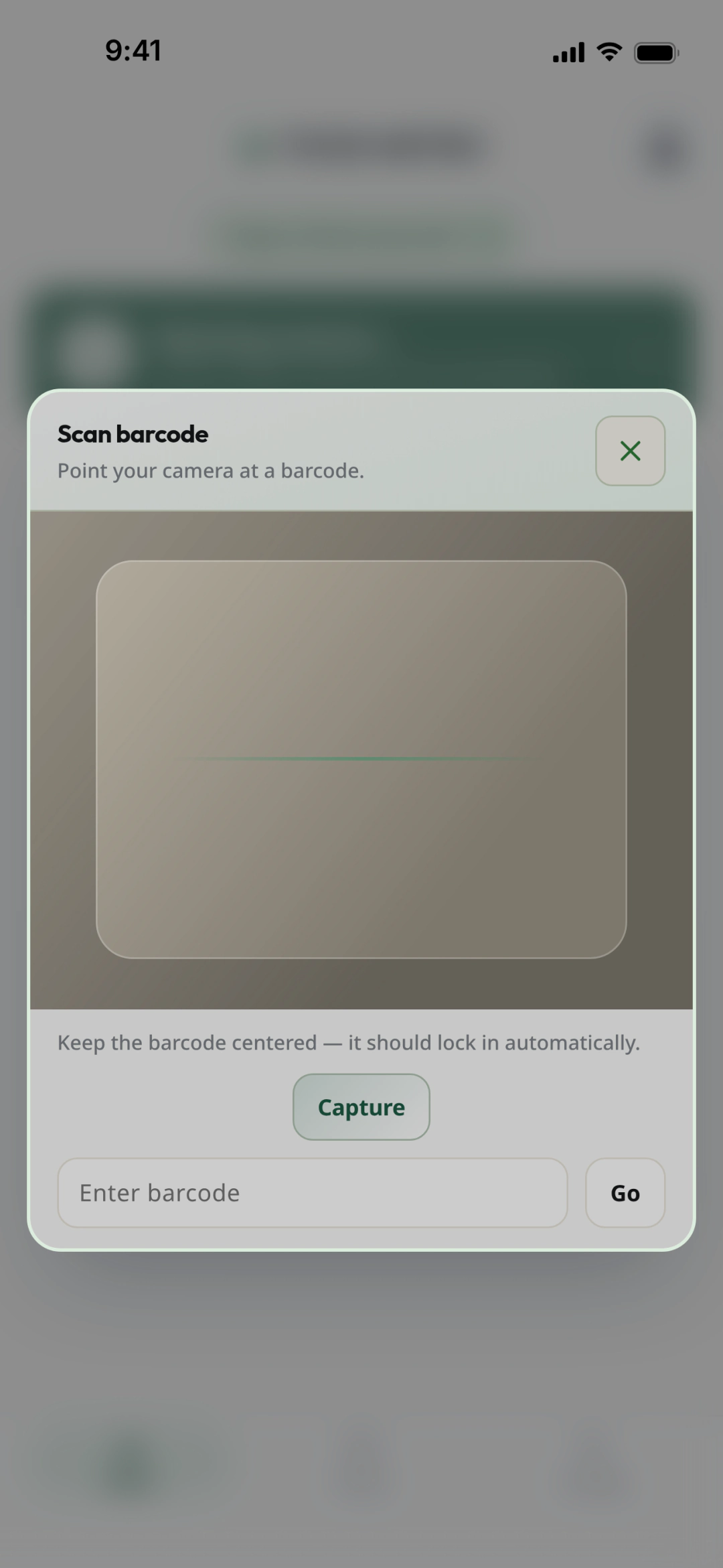
Point the camera at the barcode and it locks in on its own. If a barcode is worn, you can type the number in.
2. Find the additive in the list. The product page has an Additives section listing the additives Food Metric matched on the label. Mono- and diglycerides show up under their full name.

3. Tap it for the plain-language version.
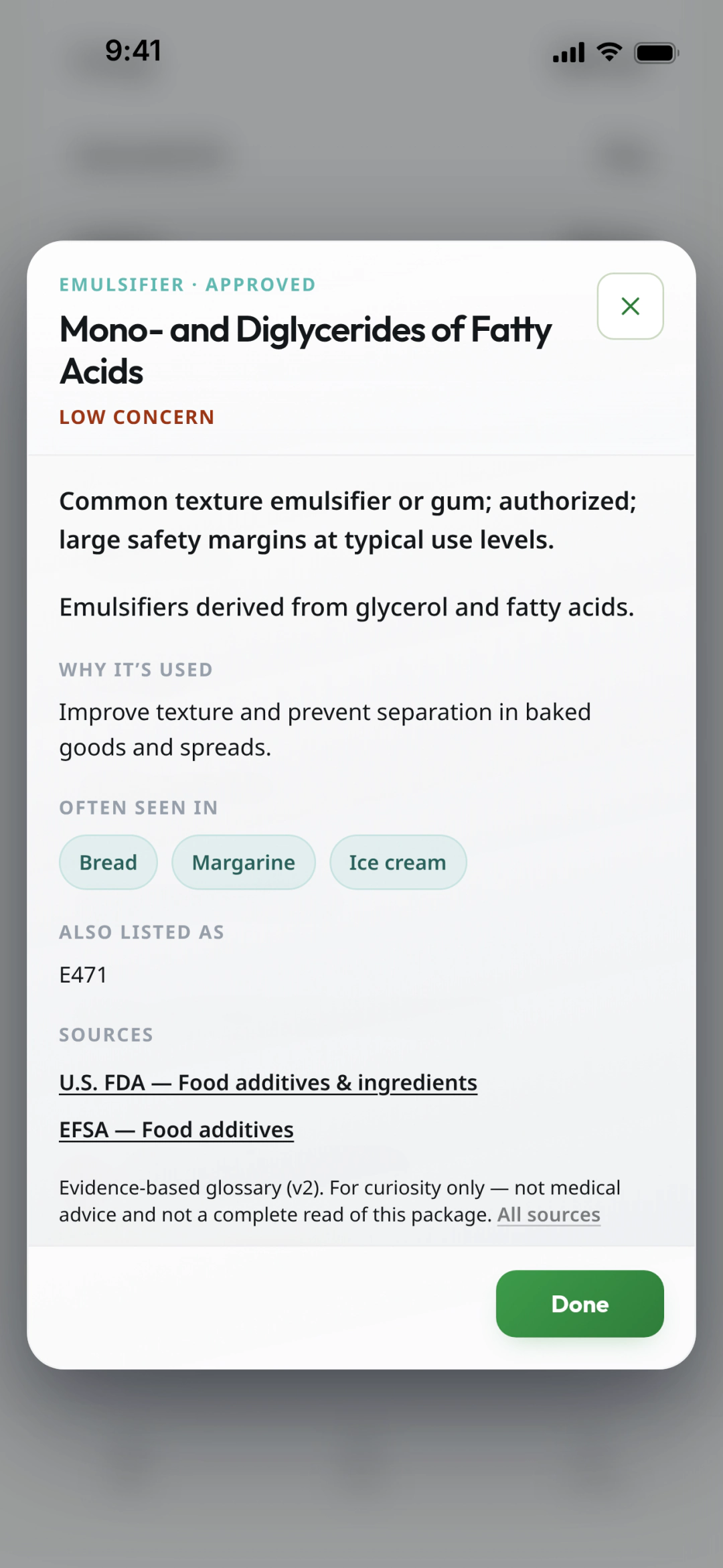
The sheet explains what the additive is, why it's used, where else it shows up, and its other label names. It links its sources (FDA and EFSA) and labels this additive "Low concern." It comes from a 500+ additive glossary.
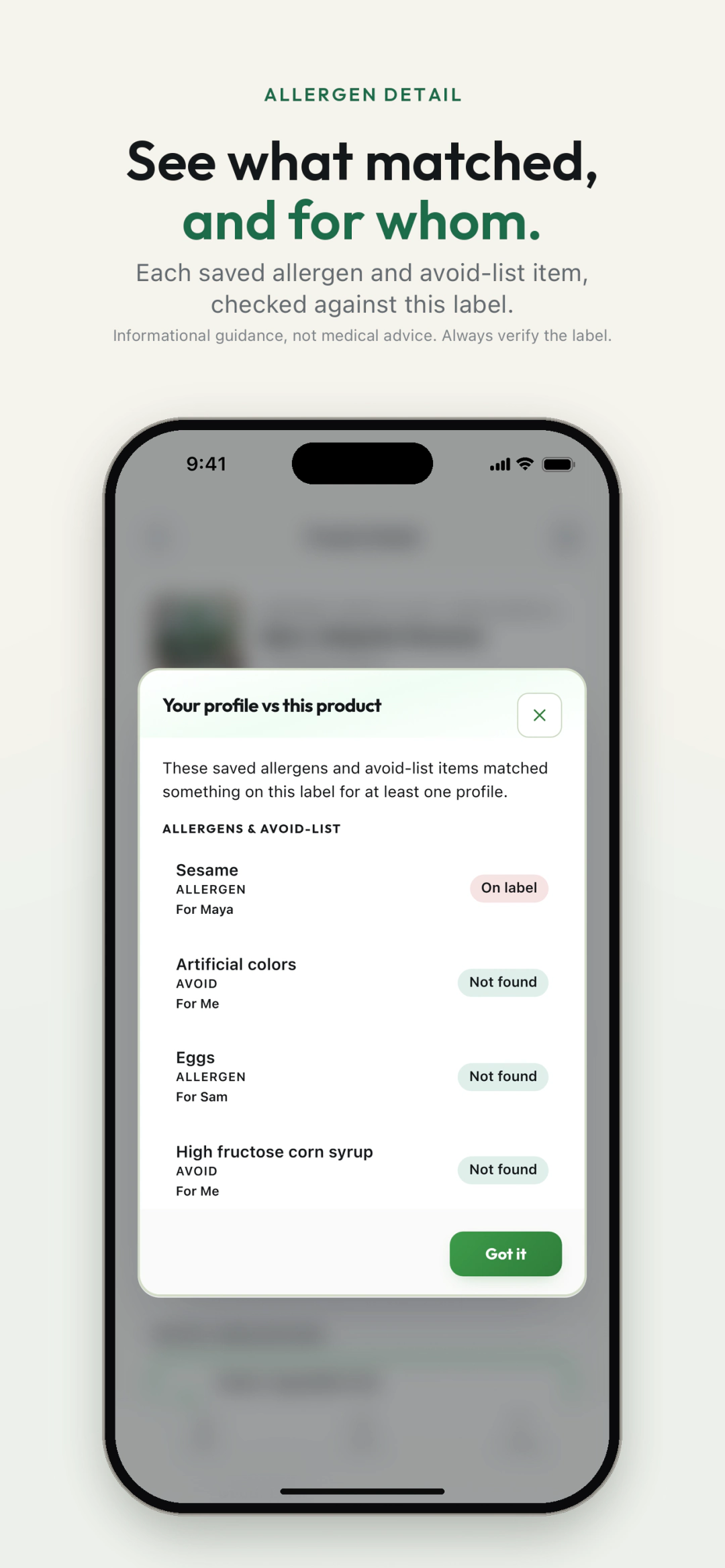
4. Get one read for the whole household. The same scan checks every profile you've set up (up to 8 people), each with its own allergens and avoid-list. Tap a person to see exactly what matched and for whom.
You also get a 1–10 Food Metric score with the reasons behind it, and a catalog of 900,000+ products you can search before you leave the house. If you're shopping for several people with different needs, our guide to grocery shopping when your family has different allergies covers the full system.
Honest limits: Food Metric works from product data, which can be incomplete or out of date. The Additives list shows the names it recognizes on that listing. If the app and the package disagree, trust the package.
A 30-second E471 routine
- Scan the pack and look for "Mono- and Diglycerides of Fatty Acids" in the Additives list.
- On the physical label, look for "mono- and diglycerides," "E471," or "471."
- If the source matters to you (vegan, halal, kosher, a specific oil), check for a certification or ask the manufacturer.
- Don't mix E471 up with E472 esters or lecithin.
Try it on your next shop
Next time a label stops you mid-aisle, scan it and tap the name. Food Metric gives you 7 days of full access free, then 3 free scans every month. Premium is $3.99/mo or $39.99/yr.
Get Food Metric on the App Store
FAQ
Is E471 the same as mono- and diglycerides?
Yes. E471 is the EU/UK code for mono- and diglycerides of fatty acids. U.S. labels usually spell out "mono- and diglycerides" instead of using the number (FSA).
Is E471 vegan?
Not necessarily. It can be made from plant oils or from animal fats such as tallow or lard, and the ingredient list usually doesn't say which (EFSA, 2017). Look for a vegan certification or ask the manufacturer.
Is E471 halal?
It depends on the source fat and how it was made, which the label doesn't show. A halal certification on the pack, or a direct answer from the manufacturer, is the reliable way to know.
Is E471 bad for you?
The FDA affirms mono- and diglycerides as GRAS, and EFSA's 2017 re-evaluation found "no safety concern at the reported uses and use levels" (21 CFR 184.1505; EFSA, 2017). For questions about your own diet, talk with your clinician.
Why is E471 in bread and ice cream?
It's an emulsifier that keeps texture smooth and even. EFSA found bread and bakery goods were the largest contributors to intake, and about 75% of dairy-based ice creams in its label database listed E471.
Is E471 a major food allergen?
No. E471 isn't one of the nine major food allergens that U.S. law requires labels to declare (FDA). Always read the ingredient list and any "Contains" statement for your household's allergens.
Not medical advice. This article is for general educational purposes about label reading and food additives. It is not a diagnosis, treatment plan, or substitute for advice from a qualified healthcare professional. Food Metric is informational guidance based on product data, which can be incomplete or out of date. Always verify the label on the package and follow your clinician's guidance for your household.