
Pick up a canister of iodized table salt and read the side panel. A typical U.S. ingredient line looks like this: "Salt, calcium silicate (an anticaking agent), dextrose, potassium iodide." It's the line our "Corn doesn't always say corn" ad shows on the fictional Clearharbor canister: a sugar in the salt, and one that's often made from corn.
This guide covers why corn can sit on a label without the word "corn," the names worth knowing, and how to check a product in a few seconds. It is not medical advice. Your clinician decides what your household needs to avoid; this is about reading labels for that list.
Why labels don't have to say "corn"
U.S. law names nine major food allergens: milk, eggs, fish, crustacean shellfish, tree nuts, peanuts, wheat, soybeans, and sesame. For those nine, the label must name the food source, either in the ingredient list ("whey (milk)") or in a "Contains" statement (FDA). Corn isn't on that list. Neither is maize on the list of 14 allergens that UK and EU labels must declare (Regulation (EU) No 1169/2011, Annex II, as retained in UK law).
So corn-derived ingredients appear under their own common names, in descending order of weight (21 CFR 101.4). There's no "Contains: corn" line to catch them for you.
FARE describes allergic reactions to corn as "very rare" but documented, and advises people with a corn allergy to get personalized guidance from an allergist (FARE). Diagnosis is a specialist's job: in one university study, 16 people had positive skin and blood tests to corn, but only 6 reacted in a supervised food challenge (Pasini et al., Allergy, 2002). Others avoid corn on a clinician's advice for other reasons, or by choice. The label-reading problem is the same.
Is dextrose corn?
Often, but the label alone can't tell you. U.S. regulations define dextrose as purified, crystallized D-glucose. The same rule lets a manufacturer call it "dextrose" or name the starch source instead, for example "corn sugar" (21 CFR 168.111). Many labels simply say "dextrose."
Corn is a common source: the University of Rochester Medical Center's corn-free diet guide lists dextrose among "the most common corn by-product names" on labels (URMC). It isn't the only source. EU and UK law specifically exempt "wheat based glucose syrups including dextrose" from wheat allergen labeling, which only makes sense because dextrose can be made from wheat (Annex II).
Bottom line: dextrose is a common corn-derived ingredient, not a certain one. If the source matters, ask the manufacturer.
Why is it in salt? U.S. iodized salt is made with potassium iodide or cuprous iodide (21 CFR 100.155). Potassium iodide can break down and lose its iodine. WHO guidance notes that producers add "sodium thiosulfate or dextrose to stabilize potassium iodide" (WHO, 2014).
The names to know
| Label name | What it is | Corn? |
|---|---|---|
| Dextrose | Purified glucose made from starch | Often corn; can be wheat (Annex II) or another starch (21 CFR 168.111) |
| Maltodextrin | A lightly sweet starch polymer used for body and bulk | Made from "corn starch, potato starch, or rice starch" in the U.S. (21 CFR 184.1444) |
| Glucose syrup | A syrup "obtained from edible starch" | Any starch. It may instead be labeled "corn syrup," "wheat syrup," or "tapioca syrup" (21 CFR 168.120) |
| Corn syrup, corn sugar, cornstarch, corn oil, high fructose corn syrup | Named after their source | Yes, and the word "corn" is right there |
| Starch, vegetable starch, modified food starch, vegetable gum, dextrin, fructose, sorbitol | Ingredients that can be made from corn | Sometimes. Hospital diet guides list these as names to check (URMC; Children's Wisconsin) |
One name you can cross off: on a U.S. label, plain "sugar" means sucrose from sugar cane or sugar beets (21 CFR 101.4(b)(20)).
Where to draw the line is your clinician's call
Hospital guidance doesn't agree on the refined sweeteners. URMC's guide lists dextrose, dextrins, corn syrup, and sorbitol among the corn by-products to read for (URMC). Children's Wisconsin's corn-allergy teaching sheet, based on the Academy of Nutrition and Dietetics' Pediatric Nutrition Care Manual, lists corn syrup, dextrose, dextrin, and sorbitol as okay to use, and asks families to check the source of maltodextrin, modified food starch, starch, vegetable gum, and vegetable starch (Children's Wisconsin).
So which names matter for your household is a decision for your clinician, not for a label or an app. It's also why Food Metric keeps "Corn" and "Corn derivatives" as two separate options: each profile can match the list its clinician set.
Three label-reading examples
- Iodized table salt: "Salt, calcium silicate (an anticaking agent), dextrose, potassium iodide." The dextrose is there to stabilize the iodide. Corn is a likely source, but the label doesn't say.
- A seasoning or drink-mix packet: "Maltodextrin, salt, spices…" Maltodextrin is a common carrier in powders. In the U.S. it comes from corn, potato, or rice starch, and the label usually doesn't say which.
- A blended cooking oil: "Vegetable oil (contains one or more of the following: canola oil, corn oil, soybean oil)." U.S. rules allow this "one or more of the following" wording when a maker switches oils between batches (21 CFR 101.4(b)(14)). Corn may or may not be in the bottle you're holding.
Checking for corn names with Food Metric
Here's the same check in Food Metric, our iPhone grocery scanner.
1. Add Corn and Corn derivatives to a profile, once. Both options sit under "Additional Allergens & Sensitivities."
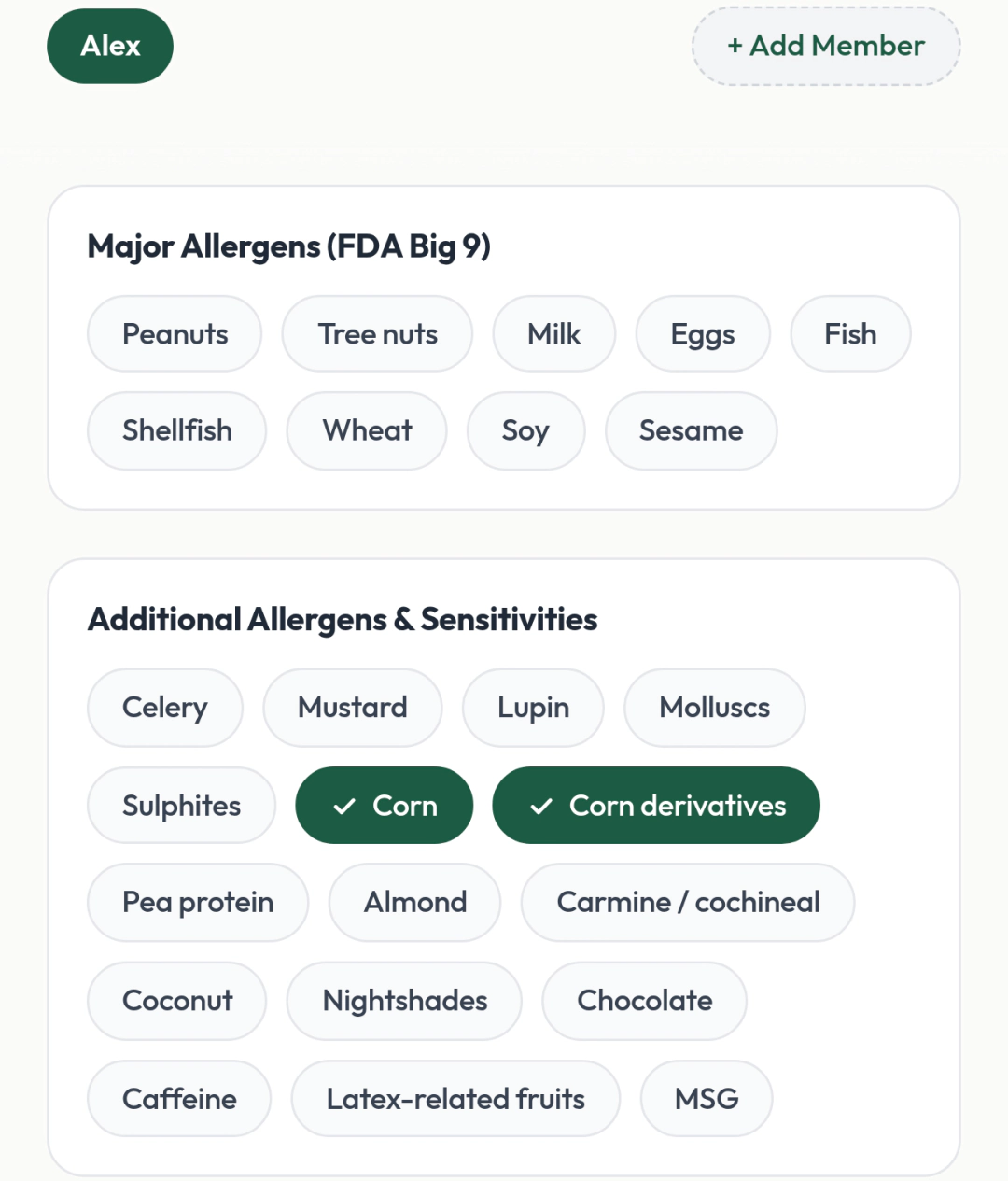
"Corn" checks ingredient lists for "corn" and "maize." "Corn derivatives" checks for dextrose, maltodextrin, and glucose syrup.
2. Scan the barcode.

The barcode locks in on its own. If it's worn, type the number in.
3. Read the verdict. On a standard iodized salt, the app flags the conflict and names the reason.
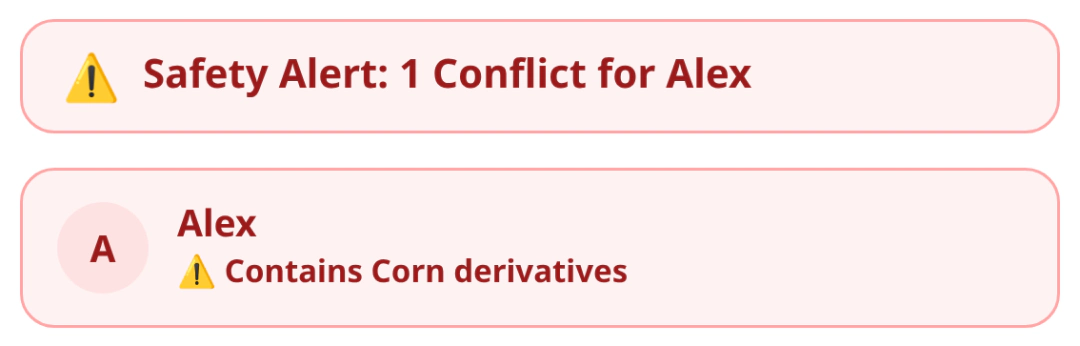
No separate "Corn" conflict appears, because the word corn isn't on this label. The match came from dextrose.
4. Confirm it in the ingredient list. Scroll to Ingredients to see the full declaration and find the name yourself.
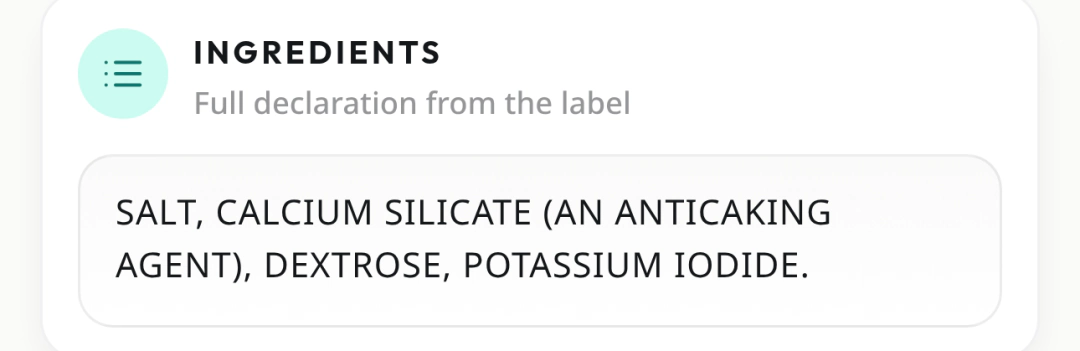
The same scan checks every profile you've set up (up to 8 people), each with its own allergens and avoid-list. You also get a 1–10 Food Metric score with the reasons behind it, and a catalog of 900,000+ products you can search before you leave the house.
Honest limits: Food Metric checks the names above, not every possible source of corn. It doesn't flag dextrin, starch, modified food starch, sorbitol, or an oil blend that doesn't say "corn," and it can't tell you whether a given dextrose came from corn or wheat. It works from product data, which can be incomplete or out of date. If the app and the package disagree, trust the package.
A 60-second corn-label routine
- Scan first, so the app checks for corn, maize, dextrose, maltodextrin, and glucose syrup.
- Then read the physical list for the "sometimes" names in the table above.
- When a name could go either way and it matters, contact the manufacturer listed on the pack, and note the answer so you only ask once.
Shopping for several people with different lists? Our guide to grocery shopping when your family has different allergies covers the full system. And if an additive name stops you mid-aisle, start with What Is E471?
Try it on your next shop
Add Corn and Corn derivatives to a profile, then scan the pantry staples you'd never think to check. Food Metric gives you 7 days of full access free, then 3 free scans every month. Premium is $3.99/mo or $39.99/yr.
Get Food Metric on the App Store
FAQ
Is dextrose made from corn?
Often, but not always. U.S. rules define dextrose as purified glucose from starch and allow it to be labeled "corn sugar" when corn is the source, though many labels simply say "dextrose" (21 CFR 168.111). It can also be made from wheat (Annex II). Ask the manufacturer if the source matters.
Is maltodextrin corn?
It can be. U.S. regulations say maltodextrin is made from corn, potato, or rice starch (21 CFR 184.1444). The label usually doesn't name the source.
Is glucose syrup the same as corn syrup?
Corn syrup is a glucose syrup made from corn starch. "Glucose syrup" on its own can come from any edible starch, including wheat or tapioca (21 CFR 168.120).
Why is there dextrose in iodized salt?
It stabilizes the potassium iodide so the salt keeps its iodine. WHO guidance names dextrose and sodium thiosulfate as the stabilizers producers use (WHO, 2014).
Do food labels have to list corn as an allergen?
Not in the U.S. Corn isn't one of the nine major food allergens that require a source declaration (FDA). It isn't on the UK's list of 14 either (Annex II). Corn ingredients still have to appear in the ingredient list under their common names.
Does Food Metric catch every corn ingredient?
No. Its "Corn" option checks for "corn" and "maize," and "Corn derivatives" checks for dextrose, maltodextrin, and glucose syrup. Always read the full label for other names, and follow your clinician's guidance.
Not medical advice. This article is for general educational purposes about label reading and food ingredients. It is not a diagnosis, treatment plan, or substitute for advice from a qualified healthcare professional. Food Metric is informational guidance based on product data, which can be incomplete or out of date. Always verify the label on the package and follow your clinician's guidance for your household.