
You're going to someone else's table this year. The host is doing their best, but you still need a plan for what you'll eat, what you'll bring, and how you'll handle a kitchen that isn't yours.
This guide is for the guest — or the parent arriving with a child who has food allergies. It covers how to ask the host, what to pack, label traps in store-bought sides and desserts you might bring, and how to check those packages before you leave. For the host's shopping and kitchen setup, see Hosting Thanksgiving With Food Allergies. This is not medical advice. Your clinician sets what you need to avoid; this is about reading labels and planning the visit.
Ask early, and be specific
FARE's first tip for guests is to "call your host in advance to learn about the menu," explain the food allergies you're managing, and ask about bringing a dish (FARE). Kids With Food Allergies (KFA) likewise says any visit "needs to begin with a conversation with the host" (KFA). A week out is better than the day before. Ask about packaged mixes and store-bought sides, not just the turkey:
- What's on the menu, and which dishes are made from a mix or a package?
- Would it help if I brought [a specific side or dessert]?
- Can we set aside a portion of [dish] before serving, with its own spoon?
- Could you keep the packaging, or a photo of the ingredient lists, so I can read them when I arrive?
FARE and the Academy of Nutrition and Dietetics both suggest asking the host to save packaging or a label photo (FARE, Academy of Nutrition and Dietetics). Be plain, not lecturing. You need a clear answer on what's being served and whether you can bring a dish. The Academy also notes that some hosts still think "a little bit won't hurt." It can, and it's fair to say so calmly (Academy of Nutrition and Dietetics).
Also decide, with your clinician's guidance, how your household treats "may contain" and "made in a facility" lines. Those are voluntary advisory statements, not required by law (FDA, FARE). Some families accept them; many don't. Tell the host your rule so they aren't guessing.
Bring a dish you trust — and enough of it
When you're unsure, FARE says to "bring a meal you trust, including a favorite treat" (FARE). The Academy also suggests offering to help plan or shop, or bringing snacks and desserts, because baked goods often include wheat, milk, eggs, tree nuts, and soy (Academy of Nutrition and Dietetics). KFA adds that some families cook with the host, and others bring a full meal for the person who needs it (KFA).
Pack more than the dish:
- Enough for seconds, in its own container with its own serving utensil, so a shared spoon doesn't add ingredients from another bowl (FARE).
- A snack for the trip. FARE says "don't show up hungry," so you (and especially a child) aren't nibbling before you've checked what's being served (FARE).
- Epinephrine as prescribed. FARE says "don't leave home without your two epinephrine auto-injectors" (FARE). The NHS likewise advises carrying two adrenaline auto-injectors at all times if they are prescribed for you (NHS). Follow your clinician's action plan; this article does not tell you how to use them.
The NHS also puts it plainly: don't eat foods "without checking what ingredients are in them first" (NHS).
Label traps in the sides and desserts you might bring
U.S. labels must name the nine major allergens — milk, eggs, fish, crustacean shellfish, tree nuts, peanuts, wheat, soybeans, and sesame — in the ingredient list (including in parentheses, like "whey (milk)") or in a "Contains" statement right after the list (FDA, FARE). Read both. Tree nuts, fish, and shellfish must be named by type. The host guide covers USDA meat labels and "may contain" in more depth.
FARE notes that a traditional meal can include soy in brines, milk in potato dishes, wheat in gravies and dressings, eggs in sauces and baked goods, nuts in vegetables, pilafs and stuffing, and all of the above in desserts (FARE). If you're bringing a packaged side or a dessert made from a mix, these are the names that tend to show up.
| Item | What to check the label for |
|---|---|
| Stuffing or dressing mix | Wheat in the bread crumbs, milk (whey, butter, cheese powder), egg, soy, and sometimes sesame. Pecans or walnuts are tree nuts; the label has to name the nut. |
| Gravy mix or jarred gravy | Wheat flour as a thickener, milk, soy. Worcestershire sauce, often used in gravy, traditionally contains anchovies (fish). The FDA lists sauces and gravies among the food types most often recalled for undeclared allergens (FDA). |
| Pie crust and baking mixes | Wheat, milk (butter or whey), soy (lecithin or soybean oil), and sometimes egg. If you switch products or sizes, read the new box. |
FARE's rule is to "read every label, every time," because ingredients and manufacturing processes can change without warning (FARE).
Whipped topping. Don't stop at the front of the carton. Some products labeled "nondairy" still contain caseinate, a milk protein. Federal rules require the source to be identified — for example, "sodium caseinate (a milk derivative)" (21 CFR 101.4(d)). Casein, sodium caseinate, and whey are all milk proteins, and the food source name "milk" must appear on the label (FDA).
Chocolate and chocolate desserts. Milk is often obvious in milk chocolate, less so in dark chocolate. The FDA has flagged undeclared milk in dark chocolate as a recurring recall issue, and it treats this category as higher risk for people avoiding milk (FDA). Read the ingredient list, the "Contains" line, and any "may contain milk" advisory.
"May contain" and "processed in a facility" lines are voluntary. Their wording is not a legal ranking of risk, and a missing line does not mean there is no cross-contact risk (FDA, FARE). Use the rule you already set with your clinician. Two other gaps: highly refined soybean oil doesn't have to be declared as a soy allergen, and bakery items boxed at the counter after you order aren't covered by the federal allergen labeling law (FDA). Skip an unlabeled bakery box, or ask staff and decide before it goes in the bag.
One scan, checked for the whole family: before you leave home
If you're packing a mix, a crust, a carton of topping, and a chocolate dessert, that's several labels to read against every person traveling with you. Food Metric, our iPhone grocery scanner, checks a packaged item against up to 8 household profiles in one scan, at the store or at your own counter before you leave.
1. Set each person's allergens and avoid-list. Add a profile for everyone traveling with you (up to 8). Each profile has its own major-allergen list, plus extra sensitivities and additives you want flagged.
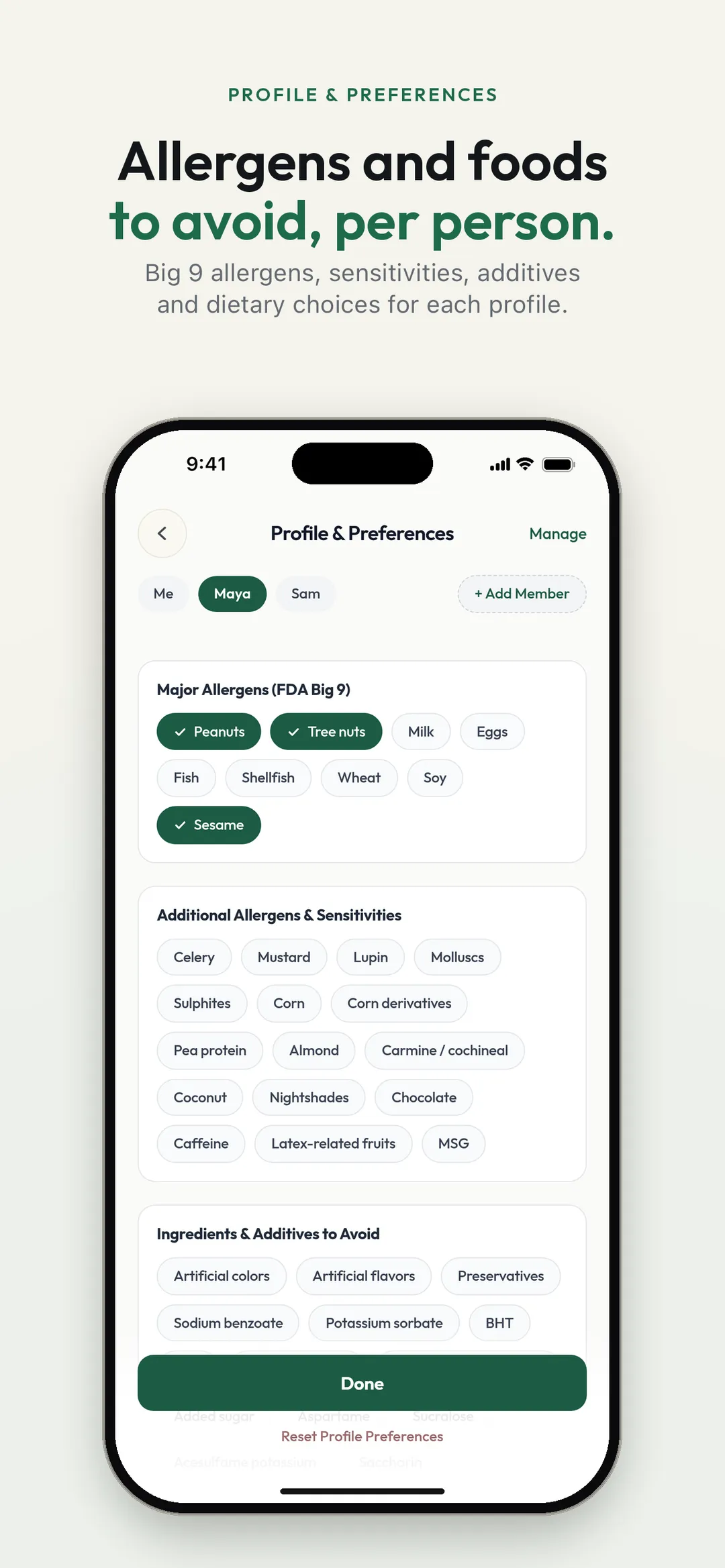
In this example, Maya's profile has peanuts, tree nuts, and sesame selected. Switch to Me or Sam to set theirs.
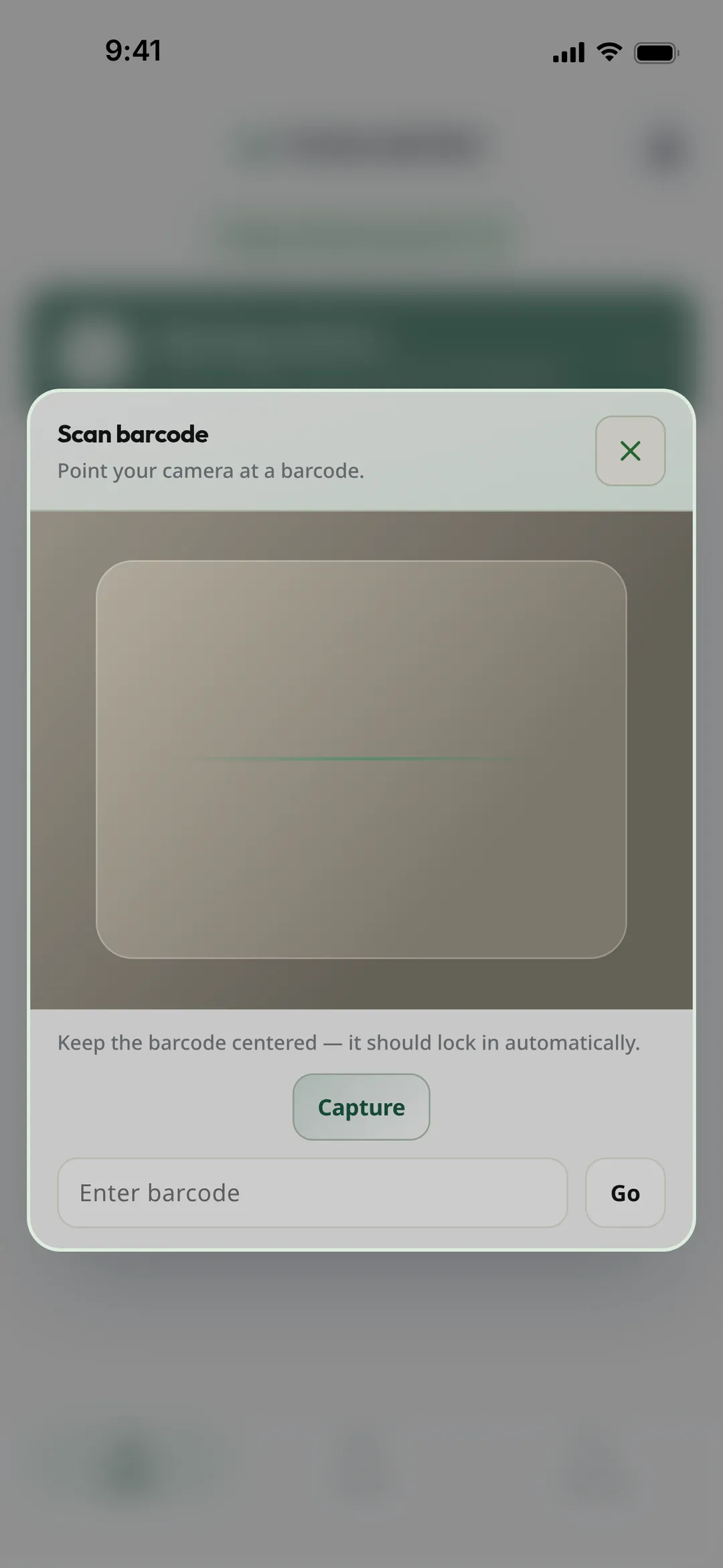
2. Scan the barcode on the package you're bringing. Point the camera at the barcode, or type the number in.
3. Open the detail to see what matched, and for whom. Each saved allergen and avoid-list item shows "On label" or "Not found."
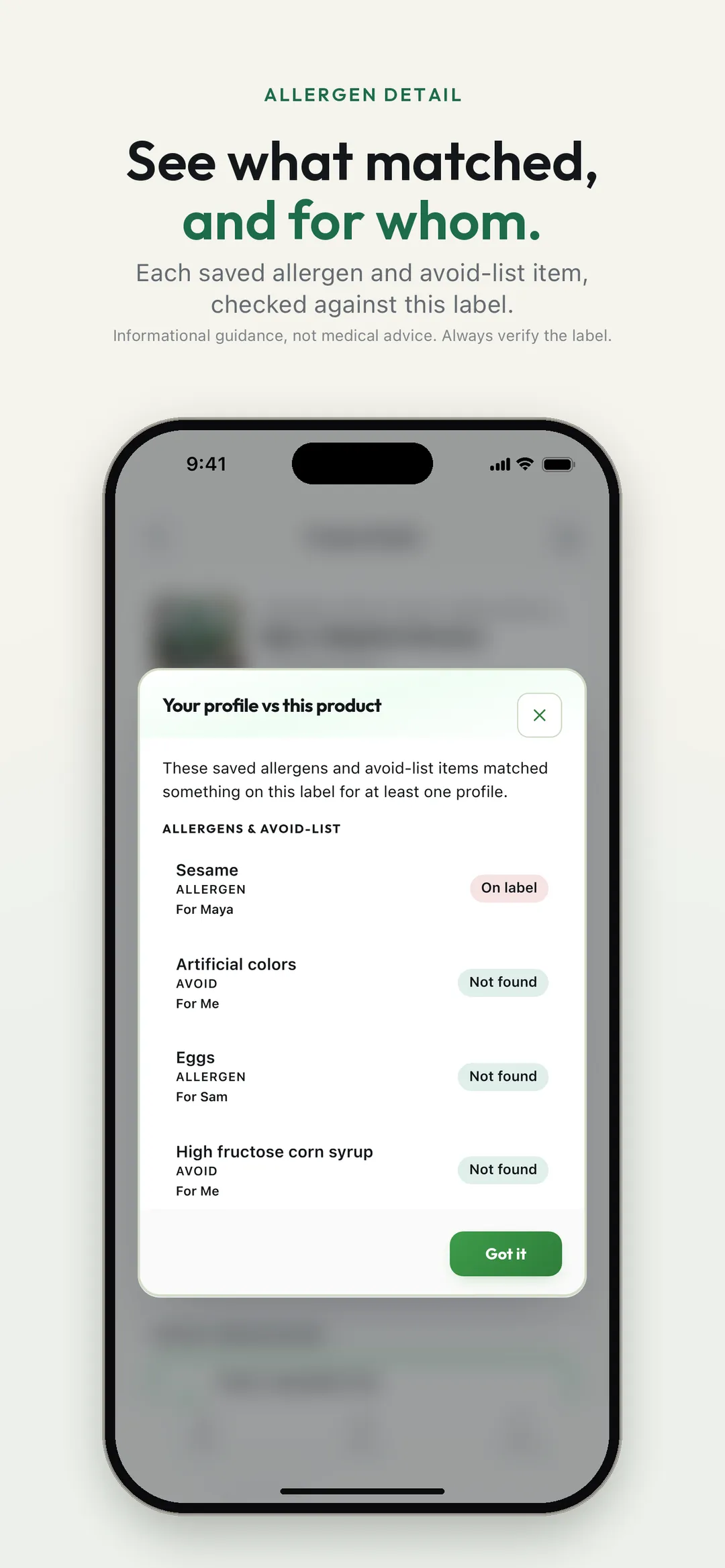
Here, sesame is marked "On label" for Maya. The other saved items are marked "Not found."
Every scan also gives a 1–10 Food Metric score and flags additives, and you can search a catalog of 900,000+ products before you shop.
Honest limits: Food Metric reads product data, which can be incomplete or out of date. It doesn't see the host's kitchen, a pie boxed at the bakery counter, or a recipe change on this year's box. Use it to narrow what you buy and bring, then read the physical package. If the app and the package disagree, trust the package. For everyday aisle habits, see how to grocery shop when your family has different allergies.
At the house, without taking over the kitchen
You've asked, packed, and checked labels. The last risks are in someone else's kitchen. Plate the portion first, before shared spoons go into every bowl — KFA suggests this to avoid cross-contact, and FARE tells hosts to let people with food allergies serve themselves first at a buffet (KFA, FARE). Keep your dish in its own container, with its own utensil. Wash with soap and water: KFA notes that hand sanitizer has not been shown to remove food allergens from hands (KFA). And stay with the plan you brought. If you can't confirm what's in a dish, don't eat it (NHS).
None of this requires taking over the kitchen. It does require being clear, and it leaves room for a host who has already read our host guide.
Check what you're bringing before you leave
Set a profile for each person traveling with you, then scan the mix, the crust, the topping, and the dessert before they go in the bag. Food Metric gives you 7 days of full access free, then 3 free scans every month. Premium is $3.99/mo or $39.99/yr.
Get Food Metric on the App Store
FAQ
What should I bring to Thanksgiving if someone in the household has food allergies?
A dish you trust, with enough for seconds, in its own container with its own serving utensil, plus a snack for the trip and epinephrine as prescribed (FARE). Read every label on what you bring, every time.
How do I ask a Thanksgiving host about food allergies?
Call ahead, walk through the menu (including packaged mixes), and ask about bringing a dish (FARE). Ask the host to save packaging or label photos, and say how your household treats "may contain" products. You don't need to lecture; you do need specifics.
Does "nondairy" on a label mean a product has no milk?
Not necessarily. Some products labeled "nondairy" still contain caseinate, a milk protein, and must identify the source — for example, "sodium caseinate (a milk derivative)" — and declare "milk" (21 CFR 101.4(d), FDA). Read the ingredient list and the "Contains" statement.
Can Food Metric check a packaged side for everyone in my household before we leave?
Yes. You can set up to 8 profiles, and one scan checks the product against all of them. Always read the package label too. Food Metric does not see the host's kitchen or an unlabeled bakery box.
Not medical advice. This article is for general educational purposes about label reading and food ingredients. It is not a diagnosis, treatment plan, or substitute for advice from a qualified healthcare professional. Food Metric is informational guidance based on product data, which can be incomplete or out of date. Always verify the label on the package and follow your clinician's guidance.