
A guest tells you their child is allergic to sesame, someone else avoids milk, and an uncle has a tree nut allergy. Most of the cooking is the easy part. The hard part is the packaged stuff: the boxed stuffing, the gravy packet, the bag of rolls, the frozen pie crust, the carton of broth.
This guide is for the host. It covers what U.S. labels have to tell you, where allergens tend to hide in a Thanksgiving menu, and how to check every package against every guest without a spreadsheet. It is not medical advice. Your guests (and their clinicians) know what they need to avoid. Your job is to read labels well and share what you find.
Step 1: Ask, then write it down
FARE's first tip for hosts is simple: "ask your guests about any food allergies they may have" (FARE). Ask a week out, and ask specifically: which foods, and whether "may contain" or shared-facility products are okay for them. Some families accept them; many don't. Don't guess.
Write one line per guest. That list is what you'll check every package against.
Step 2: Know what a U.S. label must tell you
U.S. law names nine major food allergens: milk, eggs, fish, crustacean shellfish, tree nuts, peanuts, wheat, soybeans, and sesame. Sesame became the ninth on January 1, 2023 (FDA).
For those nine, the label must name the food source in one of two ways (FDA):
- In the ingredient list, in parentheses: "whey (milk)," "lecithin (soy)," "flour (wheat)."
- In a "Contains" statement right after the list: "Contains wheat, milk, and soy."
Read both. A product can use either method, so a missing "Contains" line doesn't mean the allergen isn't in the list. Tree nuts, fish, and shellfish must be named by type ("pecans," "anchovy," "shrimp"), so "tree nuts" alone won't appear.
Three gaps hosts miss, all spelled out by the FDA:
- Meat and poultry products are regulated by USDA, not FDA, so the FDA's allergen labeling law doesn't cover them. A pre-brined or self-basting turkey, or a packaged sausage for stuffing, still lists ingredients, but read that list closely rather than relying on a "Contains" line (FDA). FARE warns that "allergens can hide in the seasonings and juices of many packaged meats" (FARE).
- Highly refined oils are exempt. A highly refined soybean oil doesn't have to be declared as a soy allergen. Whether that matters is the guest's call, so tell them it's there.
- Bakery and deli items wrapped after you order (a pie boxed at the counter, rolls bagged on request) aren't covered by the labeling law. Ask staff, or skip them for allergic guests.
Step 3: What "may contain" actually means
"May contain milk" or "made in a facility that also processes tree nuts" are advisory statements. The FDA says they are not required by law. They're meant to flag unavoidable cross-contact, and they must be truthful and not misleading (FDA).
Two practical consequences:
- No statement doesn't mean no risk. A product without a "may contain" line can still be made on shared equipment.
- The wording doesn't rank risk. "May contain" and "shared facility" aren't legally defined tiers. Don't treat one as lower risk than the other.
So this is where the guest list matters most: check what each family told you in Step 1, and if a product's line conflicts, choose a different product or ask them.
Step 4: Where allergens hide on a Thanksgiving table
FARE sums up the problem: a traditional meal can include "soy in brines and basting liquids, … milk in potato dishes, wheat in gravies and dressings, eggs in sauces and baked goods, nuts in 'special occasion' vegetables, pilafs and stuffing, and all of the above in desserts" (FARE). Here's what to look for on the packages.
| Item | What to check the label for |
|---|---|
| Boxed stuffing / dressing mix | Wheat (bread crumbs), milk (whey, butter, cheese powder), egg, soy, and sometimes sesame. Add-ins like pecans or walnuts are tree nuts; the label names the nut. |
| Gravy mix or jarred gravy | Wheat flour as the thickener, milk, soy. Worcestershire sauce, often used in gravy, traditionally contains anchovies (fish). FDA lists sauces and gravies among the food types most often recalled for undeclared allergens (FDA). |
| Broth or stock | Usually short lists, but some include milk, soy, or wheat in flavorings. Celery is common; it isn't a U.S. major allergen, so a guest avoiding it must read the list. |
| Dinner rolls | Wheat, milk, egg (often an egg wash on top), soy. Check for sesame, both in the list and in "may contain" lines, since rolls are often baked on lines shared with seeded breads. |
| Pie crust (frozen or refrigerated) | Wheat, milk (butter), soy (lecithin or soybean oil), sometimes egg. Recheck if you switch between types. |
| Pumpkin and pecan pie fillings | Milk (evaporated or condensed milk), eggs, tree nuts. |
| Marshmallows | Often short lists, but some contain egg whites or milk. Read the list and any "may contain" line. |
"Always check the label" applies every year: recipes change, and the same product in a different size can come from a different plant. FARE's advice is to "read every label, every time, especially if you're trying something new" (FARE).
Step 5: Control cross-contact in your kitchen
The label only covers the factory. Your kitchen is the last step:
- Cook the allergen-free dishes first, then cover and set them aside.
- Use separate spoons and serving utensils, and label each dish with its ingredients. FARE suggests letting guests with food allergies serve themselves first at a buffet (FARE).
- Clean surfaces and tools thoroughly between dishes (FARE).
- Keep the packaging. FARE says to "hang on to packaging, or snap a photo of the ingredients label, so that you can share that information with any guests who ask" (FARE).
And respect a guest who brings their own dish. Kids With Food Allergies recommends that families start with "a conversation with the host" and read the labels of all ingredients (KFA). The NHS likewise advises people with food allergies not to eat foods "without checking what ingredients are in them first" (NHS).
One scan, checked for the whole family: a Food Metric walkthrough
Checking eight packages against five guests means 40 label reads. Food Metric, our iPhone grocery scanner, does that cross-check in one scan.
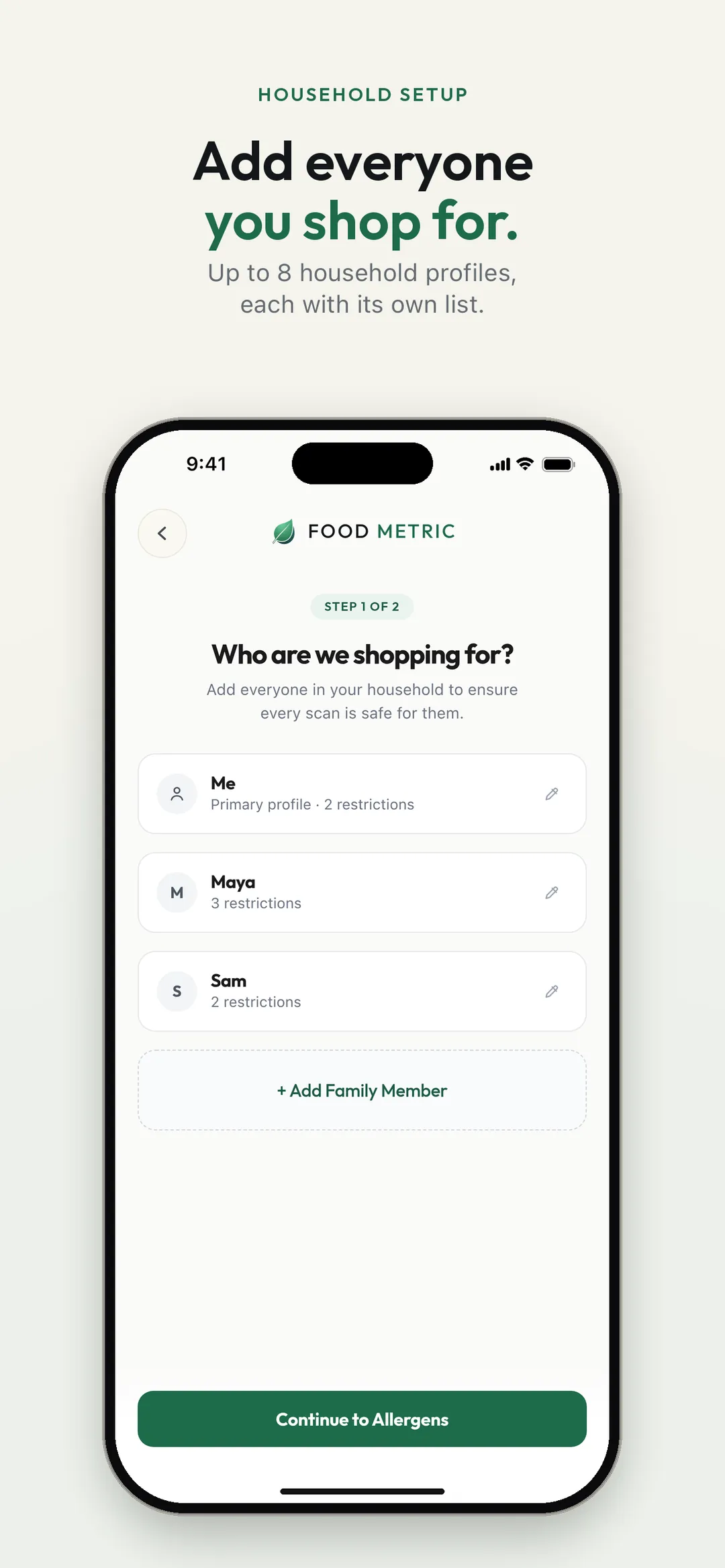
1. Add each guest or household as a profile. You can add up to 8 profiles, each with its own allergens and avoid-list.
2. Scan a package and read the household verdict. One scan checks every profile at once and shows who has a conflict.
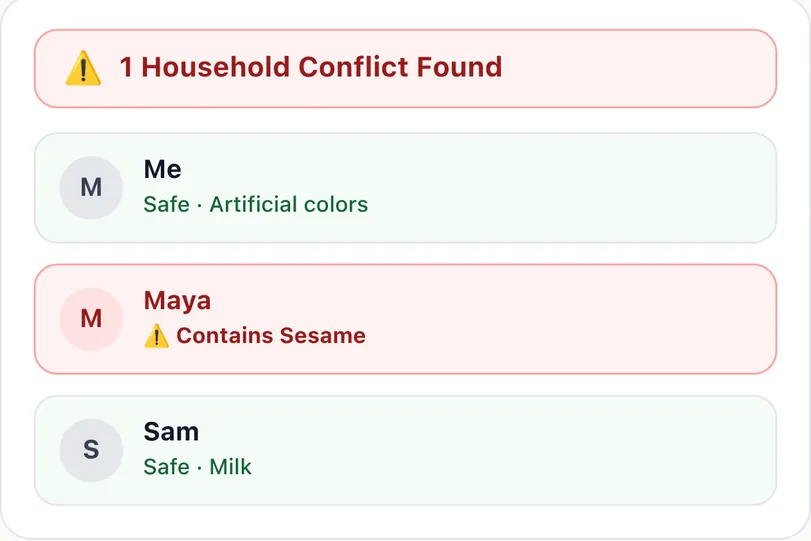
In this example, the product lists sesame. Only Maya's profile is flagged; Me and Sam show no conflict for their items.
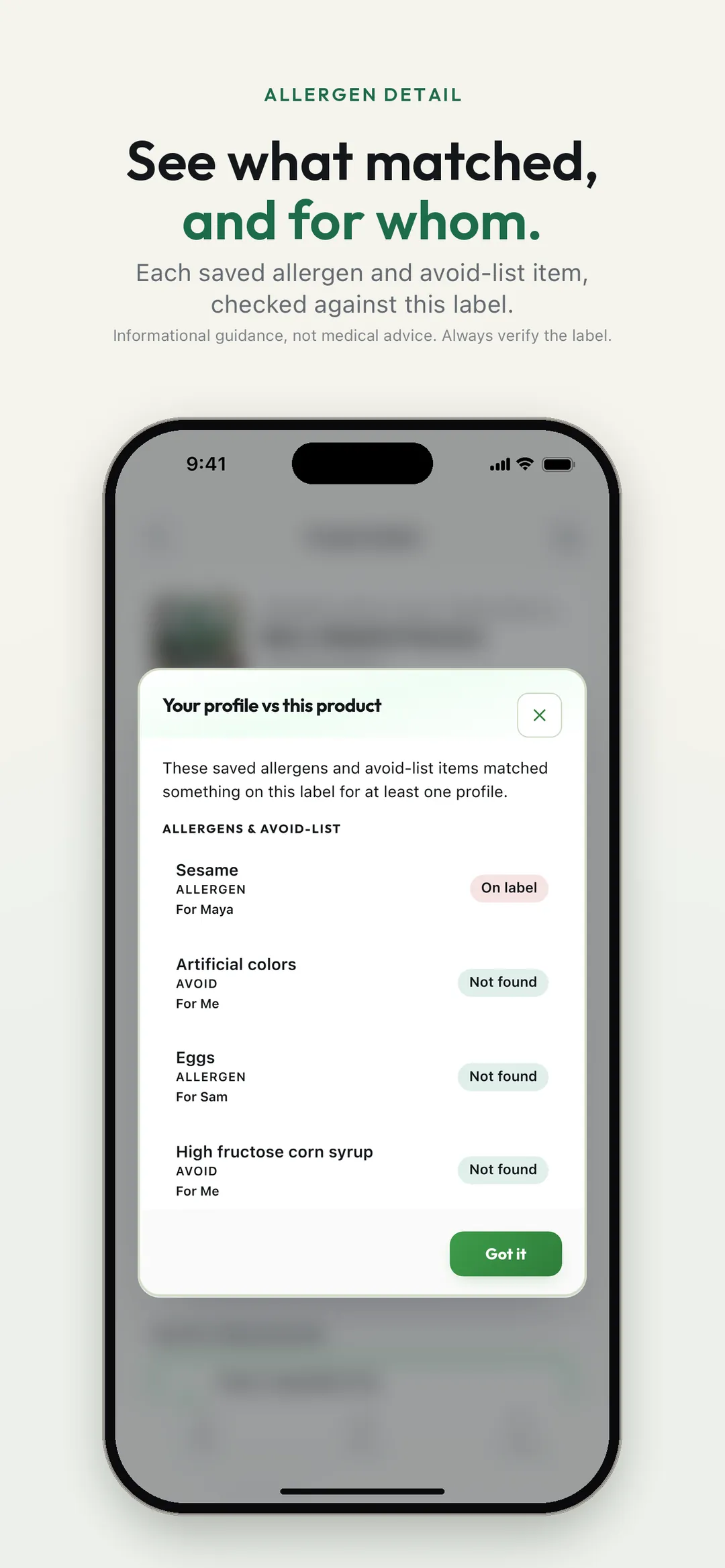
3. Open the detail to see what matched, and for whom. Each saved allergen and avoid-list item shows "On label" or "Not found."
Every scan also gives a 1–10 Food Metric score and flags additives, and you can search a catalog of 900,000+ products before you shop.
Honest limits: Food Metric reads product data, which can be incomplete or out of date. It doesn't see your kitchen, a deli-wrapped pie, or a recipe change printed on this year's box. Use it to narrow your choices, then read the physical package. If the app and the package disagree, trust the package, and when in doubt, ask your guest.
For the full shopping system, see how to grocery shop when your family has different allergies. If an additive name stops you, start with What Is E471?, and for corn-avoiding guests, Hidden Corn Ingredients. Going to someone else's table instead? See Going to Thanksgiving With Food Allergies.
Make this year's shopping list easier
Set up a profile for each guest, then scan the stuffing box, the gravy packet, and the rolls before they go in the cart. Food Metric gives you 7 days of full access free, then 3 free scans every month. Premium is $3.99/mo or $39.99/yr.
Get Food Metric on the App Store
FAQ
What are the 9 major food allergens in the U.S.?
Milk, eggs, fish, crustacean shellfish, tree nuts, peanuts, wheat, soybeans, and sesame. Sesame was added effective January 1, 2023 (FDA).
Does "may contain" mean a food has the allergen in it?
Not necessarily. It's a voluntary advisory statement about possible cross-contact, not required by law (FDA). Ask each guest whether they accept these products.
Do turkey labels have to list allergens?
Meat and poultry are regulated by USDA, so the FDA's allergen labeling law doesn't apply to them (FDA). Read the full ingredient list on brined or seasoned birds, gravy packets that come with them, and sausage.
Can Food Metric check one product for several guests?
Yes. You can set up to 8 profiles, and one scan checks the product against all of them. Always read the package label too.
Not medical advice. This article is for general educational purposes about label reading and food ingredients. It is not a diagnosis, treatment plan, or substitute for advice from a qualified healthcare professional. Food Metric is informational guidance based on product data, which can be incomplete or out of date. Always verify the label on the package and follow your guests' and clinicians' guidance.